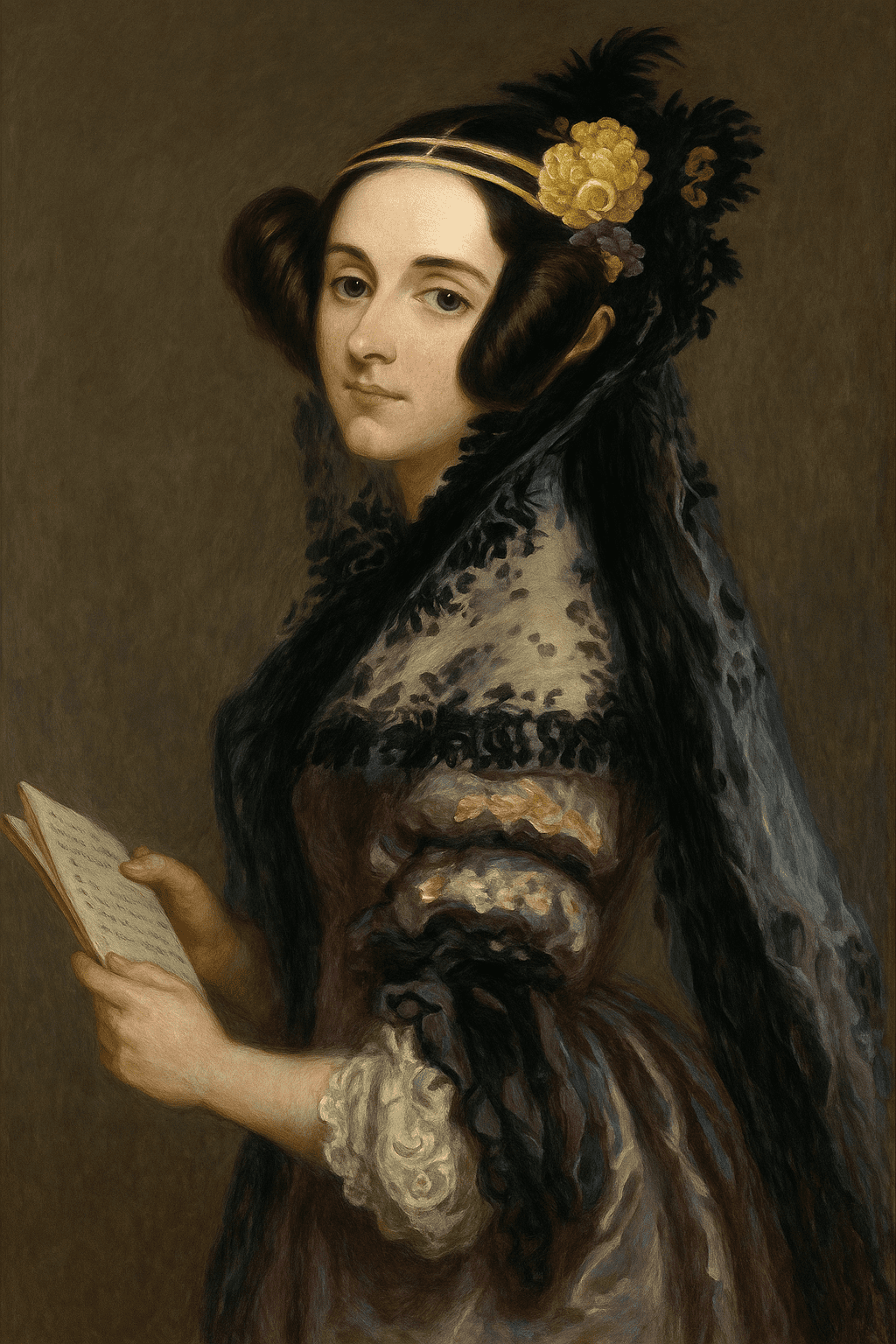
Ada Lovelace’s name often pops up when people trace the roots of computer science. Born in the early 1800s, she lived in an era when women had little access to advanced mathematics, yet she still carved out a legacy that makes her unforgettable. Historians consistently celebrate her as a visionary mathematician and first computer programmer, not because she built machines, but because she saw possibilities no one else imagined.
Early Life Shaped by Contrasts
Born Augusta Ada Byron in 1815, she was the daughter of the famous poet Lord Byron and Anne Isabella Milbanke. The marriage collapsed shortly after Ada’s birth, and her mother insisted on mathematics and logic lessons to counterbalance the “dangerous” imagination inherited from her poet father. The strict focus on science nurtured discipline, while Ada’s natural creativity kept curiosity alive. That unusual mix produced the foundation for a visionary mathematician and first computer programmer whose impact only grew after her death.
Meeting Charles Babbage and the Difference Engine
Charles Babbage, known as the “father of the computer,” designed mechanical devices like the Difference Engine and the Analytical Engine. When Ada first saw the prototype in London, she became captivated by its potential. She grasped the deeper significance beyond a machine crunching numbers. In her notes, Ada described how the device could handle symbols, not just digits, which meant it could process information in ways that hinted at modern computing. Observers would later call her insights the first step toward a visionary mathematician and first computer programmer.
The Analytical Engine and Ada’s Famous Notes
Babbage’s Analytical Engine never reached full construction, but Ada translated an Italian article about it and, more importantly, added extensive notes of her own. Those notes, longer than the article itself, contained what many now recognize as the first algorithm intended for a machine. In other words, she didn’t just explain how the device worked—she explained how to make it perform specific tasks. That foresight cemented her role as a visionary mathematician and first computer programmer.
Imagination Meets Mathematics
What set Ada apart was her ability to combine rigorous mathematics with creative imagination. She predicted the machine could manipulate symbols, compose music, or even create art if instructed with the right algorithms. Such statements might have sounded fanciful to her peers, but today they read like an uncanny prediction of modern computing. Scholars studying her letters at Britannica point to her writings as the clearest evidence of her role as a visionary mathematician and first computer programmer.
Challenges and Doubts
Ada’s life wasn’t easy. She faced constant health problems, often confined to bed for long stretches. Critics dismissed her ideas, attributing her insights to Babbage or claiming she exaggerated her contributions. Over time, however, scholars recognized the originality in her notes and her clear authorship. Those reassessments restored her rightful title as a visionary mathematician and first computer programmer.
Personal Struggles Beyond the Equations
Personal letters reveal a restless spirit who wrestled with gambling debts, bouts of illness, and strained relationships. Despite struggles, she clung to scientific ambition, trying to form networks of scientists and mathematicians who could help her expand her ideas. The story of her life proves that brilliance often comes wrapped in imperfection. Readers today find inspiration in her humanity, not just in the fact she became a visionary mathematician and first computer programmer.
A Legacy Rediscovered
For many decades after her death in 1852, Ada’s work slipped into obscurity. Computers didn’t exist yet, and her notes seemed like speculative philosophy. By the 20th century, historians revisited her writings and realized she had outlined concepts that foreshadowed modern software. In 1980, the U.S. Department of Defense even named a programming language “Ada” in her honor, ensuring new generations encountered the legacy of a visionary mathematician and first computer programmer. Details about the language appear at Computer History Museum.
Modern Relevance
Tech leaders and educators often point to Ada’s blend of logic and imagination as a model for innovation. Coding isn’t just about syntax and logic—it’s also about envisioning what machines can accomplish. Students celebrate “Ada Lovelace Day” each October to highlight women in science, technology, engineering, and mathematics. The movement underscores her influence as a visionary mathematician and first computer programmer who helped open doors for women in computing.
Key Lessons from Ada’s Work
- Imagination matters: She showed that envisioning new possibilities drives innovation.
- Documentation is powerful: Her notes endure as historical milestones because she wrote clearly and thoroughly.
- Cross-disciplinary thinking works: Ada combined math with creativity, predicting applications others missed.
- Perseverance pays: Despite illness and skepticism, she left an indelible mark.
Where to Explore More
- Encyclopædia Britannica — Ada Lovelace biography
- Computer History Museum — Ada Lovelace
- Science History Institute — Ada Lovelace profile
- National Geographic — Ada Lovelace’s visionary insights
Why Ada Lovelace Still Inspires
Technology evolves at a pace Ada could never have imagined, yet her vision still feels fresh. Every time a student learns to code, every time an algorithm helps solve a problem, her spirit echoes through the process. Ada Lovelace proved that numbers alone don’t define limits; imagination expands them. Writers, scientists, and engineers continue to celebrate her as a visionary mathematician and first computer programmer because her insights remain timeless.
Check out our other website, youimpressed.com

Lead Writer, Wellness | YouImpressed.com
Rachel covers the ever-evolving world of wellness, blending science, trends, and personal insight into content that’s informative and inspiring. From red light therapy to adaptogenic teas and next-gen wellness tech, she is constantly exploring what helps people feel better and live well.
Raised in San Diego, Rachel earned her degree in Health Communications from UCSD, where she also competed on the university swim team. When she is not testing the latest wellness gadgets or reviewing top-tier retreats, you’ll find her running or swimming along the beaches of Southern California.
Note: This is a fictional bio. See About page for more information.