
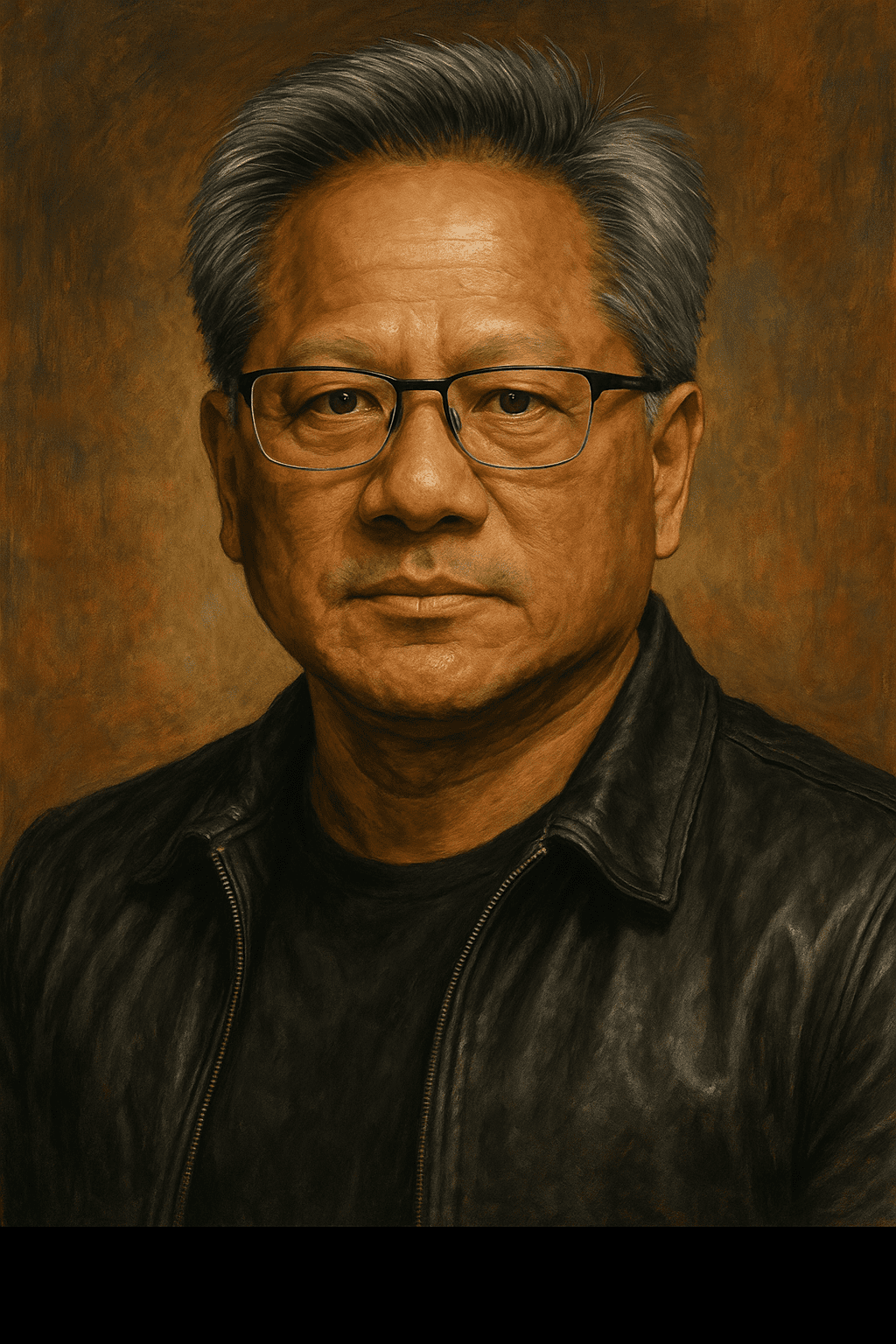
Jensen Huang: The NVIDIA Leader Shaping the Future of AI and Graphics
Jensen Huang doesn’t walk into a room quietly. He’s the kind of leader who brings both presence and vision, often showing up in his signature leather jacket. As the co-founder and CEO of NVIDIA, Huang has built a company that not only powers video games but also fuels research labs, data centers, and self-driving cars. Few people have done more to shape the Future of AI and Graphics than him.
From Taiwan to Silicon Valley
Born in Taiwan and raised in the U.S., Huang’s story feels like something pulled from a movie. He started with humble beginnings, even working as a dishwasher in his youth. That mix of grit and ambition eventually pushed him to study electrical engineering at Oregon State and then Stanford. Armed with knowledge and an unstoppable drive, he co-founded NVIDIA in 1993. Back then, the dream was to make graphics chips for gaming. Nobody could have predicted how far that dream would go.
Fast forward to today, and NVIDIA has become a cornerstone of the tech world. Huang’s vision turned a gaming chip company into a powerhouse, shaping the Future of AI and Graphics across industries.
The Gaming Revolution
Ask any gamer what makes their favorite titles look incredible, and chances are they’ll say “NVIDIA GeForce.” Huang and his team redefined gaming by pushing the limits of graphical processing. Real-time ray tracing, realistic lighting, and ultra-smooth frame rates? That’s NVIDIA’s handiwork. Under Huang’s leadership, graphics became more than visuals—they became immersive experiences.
But Huang wasn’t content with just being the king of gaming. He saw the raw computational power of GPUs and asked a bigger question: what else can these chips do?
The Leap Into AI
That question changed everything. Huang realized GPUs weren’t just great at graphics—they were perfect for the parallel processing needed in machine learning. Suddenly, NVIDIA wasn’t just a gaming company anymore. It became an AI company. Researchers started using NVIDIA chips to train neural networks, fueling breakthroughs in voice recognition, self-driving cars, and healthcare. In short, Huang’s vision helped kickstart the Future of AI and Graphics in ways few people imagined.
Companies like OpenAI and universities worldwide leaned on NVIDIA’s hardware to power their research. Without those GPUs, many of the AI models we use today wouldn’t even exist.
Deep Learning and Data Centers
NVIDIA’s growth under Huang extended far beyond gaming rigs. Data centers became the new frontier. With the rise of deep learning, cloud providers needed massive amounts of processing power. Huang positioned NVIDIA right at the heart of it, making the company indispensable to tech giants like Google, Microsoft, and Amazon.
Think of it this way: while CPUs are like reliable workhorses, GPUs are like race cars built for speed. Huang bet that the world would need more speed, and he was right. That gamble secured NVIDIA’s place in shaping the Future of AI and Graphics at a global scale.
Autonomous Vehicles and Robotics
Huang’s vision didn’t stop at data centers. He saw how AI could transform transportation. NVIDIA began developing platforms for autonomous vehicles, giving cars the “brains” to process information in real time. From startups to established automakers, everyone wanted NVIDIA’s technology. Huang was quick to remind the world that GPUs weren’t just about pretty pixels—they were about survival, safety, and the next era of mobility.
Robotics, too, became part of the portfolio. By giving machines the ability to perceive and respond to their environment, Huang pushed NVIDIA into fields once thought purely science fiction. All of this contributed to his broader vision for the Future of AI and Graphics.
Leadership Style
What makes Huang stand out isn’t just his business sense. It’s his authenticity. He’s approachable, passionate, and not afraid to delve into the technical details of discussions. Employees often describe him as someone who inspires loyalty not through fear but through vision. He’s a storyteller, turning complex tech into narratives people can actually understand. That skill makes him more than just a CEO—it makes him a guide for the industry.
And yes, the leather jacket has almost become part of his brand. It’s symbolic of how he’s both relatable and larger-than-life, blending Silicon Valley’s incredible with engineer nerdiness. Somehow, it works.
Challenges and Rivalries
Of course, it hasn’t been smooth sailing. NVIDIA has faced intense competition from companies like AMD and Intel. Supply chain issues, chip shortages, and global politics around semiconductors have created hurdles. But Huang thrives on challenges. Instead of backing down, he uses them as fuel to push innovation harder. Every setback seems to reinforce his role in driving the Future of AI and Graphics.
The Arm Deal That Wasn’t
In 2020, NVIDIA announced its intention to acquire Arm, a leading semiconductor design company. The deal would have been massive, reshaping the semiconductor industry. Regulators, however, blocked the move, citing antitrust concerns. While some saw this as a blow to Huang’s ambitions, he spun it as a learning moment. For him, one failed deal doesn’t derail the mission. He kept NVIDIA moving forward, focusing on what the company does best: innovating.
Why Jensen Huang Matters Now
The world is racing toward an AI-driven future, and GPUs sit at the center of it all. Whether it’s training chatbots, developing medical breakthroughs, or simulating climate change, NVIDIA chips are behind the curtain. Huang’s foresight turned what once looked like “just a graphics company” into a global leader of innovation.
As governments and businesses scramble to understand AI, Huang provides both the tools and the roadmap. He’s not just shaping gaming anymore—he’s shaping how societies adapt to the Future of AI and Graphics.
The Human Touch
Despite leading a multibillion-dollar company, Huang often speaks about his humble beginnings. He credits hard work, persistence, and a deep love for engineering. That humility makes his story relatable, even if his success seems larger than life. He hasn’t forgotten the dishwasher job. Maybe that’s what keeps him grounded while leading one of the most powerful companies in tech.
Friends and colleagues often describe him as relentlessly optimistic. He sees problems not as walls but as puzzles waiting to be solved. That attitude is contagious, and it shows in NVIDIA’s culture.
Final Thoughts
Jensen Huang’s legacy is still being written. From revolutionizing gaming to fueling breakthroughs in medicine and transportation, his vision has expanded far beyond pixels on a screen. He stands as a leader who not only embraces technology but also redefines it. Few people have managed to influence so many industries at once, and even fewer have done it with his mix of charisma and technical depth.
The Future of AI and Graphics isn’t just coming—it’s already here. And Huang is one of the main reasons why. His story is proof that bold ideas, mixed with persistence and creativity, can change the world in ways we’re only beginning to grasp.
Check out our other website, youimpressed.com.

Lead Writer, Smartphones | YouImpressed.com
Nathan Wells, also known as the smartphone guru, makes mobile tech both entertaining and informative. He earned his degree in Media Technology from the University of Southern California, attending on a full scholarship after winning a national competition for designing a smartphone app that turned smartphones into mini metal detectors.
In his spare time, Nathan enjoys spending time with his girlfriend and designing a new app that utilizes low-frequency signals, similar to those used in heat-seeking radar, to locate lost cats. The app has not found any cats yet.
Note: This is a fictional bio. See About page for more information.