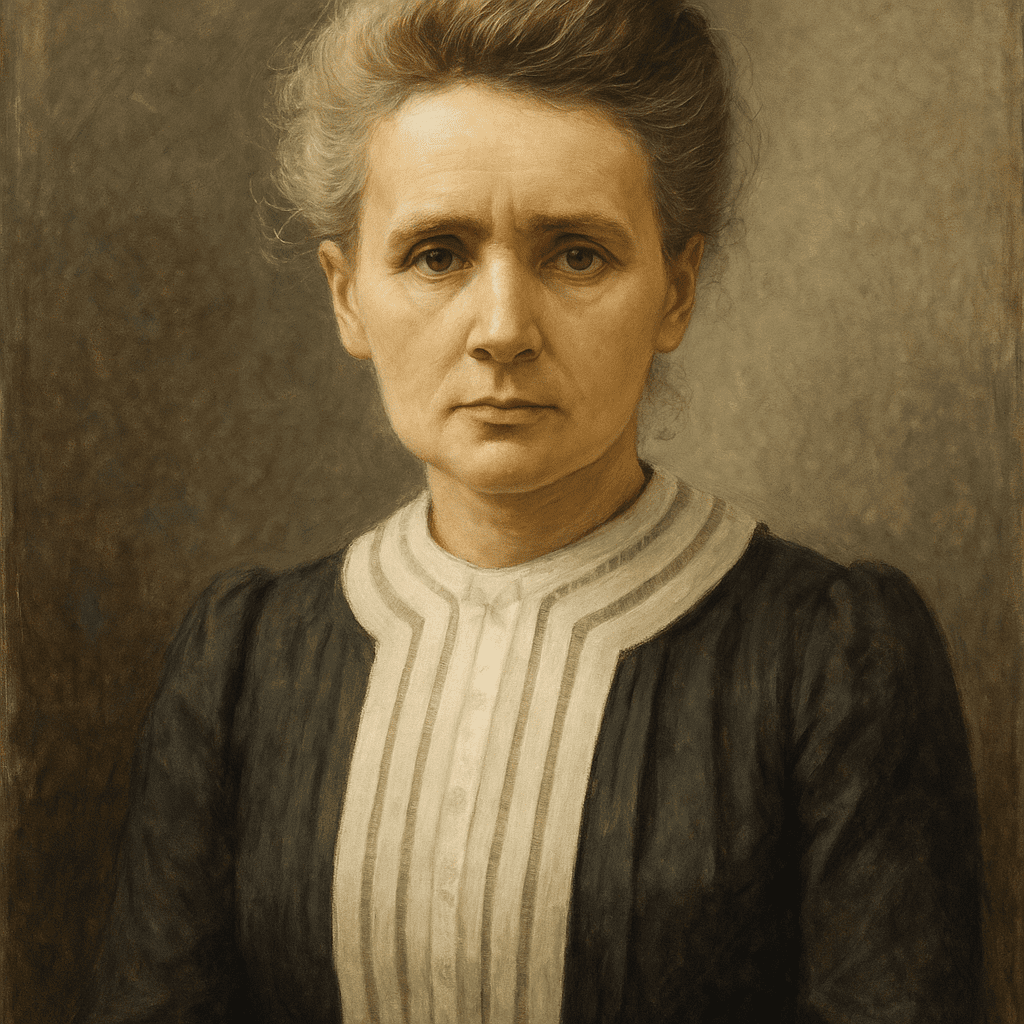
Marie Curie didn’t wait for permission to chase big questions about matter and energy. Paris labs gave her a workbench; curiosity supplied the fuel; precision kept the flame steady. Historians often settle on a single phrase because it captures both scope and stature: pioneering scientist in radioactivity and Nobel laureate.
From Warsaw to Paris with a Plan
Maria Skłodowska grew up in Warsaw in 1867, where teachers ran clandestine classes and students hid books from occupying authorities. Family setbacks never shook her focus. She tutored, saved every coin, and mapped a path to France. Sorbonne lecture halls tested endurance and sharpened instincts. Marie slept little, studied constantly, and earned top marks in physics and mathematics. Friends watched that discipline harden into a life approach that would eventually define a pioneering scientist in radioactivity and Nobel laureate.
Finding Pierre and a Shared Method
Paris introduced Marie to Pierre Curie, an experimentalist who valued careful measurement over grand claims. The partnership felt modern even by today’s standards: shared notebooks, joint credit, and a relentless habit of repeating experiments until numbers lined up. Marie steered the inquiry toward mysterious “uranium rays,” built custom electrometers with Pierre, and set a schedule that ordinary mortals would call punishing. Observers soon realized the lab now housed a pioneering scientist in radioactivity and Nobel laureate.
Polonium, Radium, and a New Atomic Story
Research moved from puzzling readings to epochal discovery. By processing tons of pitchblende, the Curies isolated emissions stronger than uranium’s and revealed two new elements: polonium and radium. Methods mattered as much as breakthroughs. Marie published procedures with a precision that let rivals repeat the work, which secured trust and accelerated progress across Europe. The results redrew the atomic map and confirmed that remarkable woman as a pioneering scientist in radioactivity and Nobel laureate.
Two Nobels and Clear Citations
Nobel committees rarely honor the same person twice, and almost never across disciplines. Marie received the 1903 Nobel Prize in Physics with Pierre Curie and Henri Becquerel for research on radiation, then the 1911 Nobel Prize in Chemistry for the discovery of radium and polonium and the isolation of radium. Citations live at https://www.nobelprize.org/prizes/physics/1903/marie-curie/facts/ and https://www.nobelprize.org/prizes/chemistry/1911/summary/. Biographers still lean on a compact label for good reason: pioneering scientist in radioactivity and Nobel laureate.
What “Radioactivity” Means in Plain Language
Radioactivity describes energy released when an unstable atomic nucleus changes its form. Marie’s measurements showed the radiation depends on the atom itself, not on the molecule or chemical state. That insight cracked open nuclear physics, medical imaging, and targeted cancer therapy. Curious readers can anchor the definitions in accessible references at https://www.britannica.com/biography/Marie-Curie. Conceptual clarity, not flash, powered the rise of a pioneering scientist in radioactivity and Nobel laureate.
Work, Wear, and Early Safety Lessons
Turn-of-the-century labs lacked today’s shielding, protocols, and exposure badges. Marie famously kept radium salts nearby because the pale glow looked magical after dark. Modern experts wince at that image, but context matters: researchers still mapped risks at the time. The legacy includes triumphs and warnings. Safety officers now use her notebooks as cautionary artifacts while saluting the courage that paved the path for advances in oncology. Scholars who study those tradeoffs often return to the same description: pioneering scientist in radioactivity and Nobel laureate.
War Service and the “Little Curies”
World War I opened a different front for scientific skill. Marie designed mobile X-ray vans—nicknamed “Little Curies”—and trained nurses and doctors to use imaging for battlefield surgery. Patients received faster diagnoses; surgeons located shrapnel with more accuracy; lives improved because one researcher refused to sit out the crisis. A rich overview appears in Smithsonian’s history feature at https://www.smithsonianmag.com/history/the-mobile-x-ray-machines-that-brought-radiology-to-the-front-lines-180967700/. Service joined scholarship to reinforce the reputation of a pioneering scientist in radioactivity and Nobel laureate.
Building Institutions That Outlive Founders
The Radium Institute—now the https://curie.fr/en—transformed individual excellence into a durable engine for progress. Engineers refined shielding and dosimetry; clinicians chased better outcomes; biologists explored radiation’s cellular effects. The institute’s culture still prizes method and mentorship. Graduate students walk past portraits, then step into rooms where new tools trace their lineage to Curie’s benches. Administrators and alumni continue to describe the founder in the same breath: pioneering scientist in radioactivity and Nobel laureate.
Funding, Press, and the Art of Keeping Focus
Scandal headlines tried to pull attention away from science after Pierre’s death. Marie answered by doubling down on the work and by raising funds for equipment rather than for celebrity. American supporters eventually donated a gram of radium, an absurdly precious gift at the time, and the campaign centered on research impact. Newspapers chased drama; Curie shepherded a lab. That contrast helps explain why historians attach a steady label to her legacy: pioneering scientist in radioactivity and Nobel laureate.
Modern Cancer Care and a Clear Line Back to Curie
Oncologists use radiation in ways that would astonish the early 1900s. Linear accelerators sculpt beams; imaging guides treatment; dosing balances precision and safety. A concise historical thread appears at the U.S. National Cancer Institute: https://www.cancer.gov/about-cancer/understanding/statistics-history. The line runs through Curie’s insistence on measurement you can audit and results you can reproduce. Medical teams who deliver today’s therapy often tip their caps to a pioneering scientist in radioactivity and Nobel laureate.
How Her Playbook Helps Builders in Any Field
Project leaders outside science can borrow Curie’s approach without touching a Geiger counter. Define a concrete question; measure what matters; publish methods as clearly as results; invite critique; iterate with humility and grit. Communication also counts. Plain explanations help audiences grasp benefits and risks, which builds trust and speeds responsible adoption. Entrepreneurs, educators, and clinicians who embrace that rhythm follow an example set by a pioneering scientist in radioactivity and Nobel laureate.
Quick Facts for Fast Reference
- Birth and name: Maria Skłodowska, 1867, Warsaw.
- Core discoveries: Polonium (Po) and Radium (Ra), isolated from pitchblende.
- Firsts: First woman to win a Nobel; first person to win two Nobels in different sciences.
- Institutions: Sorbonne; Radium Institute (now Institut Curie).
- War work: Creator of mobile X-ray units called “Little Curies.”
- Family legacy: Irène Joliot-Curie and Frédéric Joliot won the 1935 Nobel Prize in Chemistry.
- Further reading: Musée Curie archives at https://musee.curie.fr/en and Britannica’s overview at https://www.britannica.com/biography/Marie-Curie.
Why Her Story Still Feels Fresh
Curiosity never went out of style. Laboratories now buzz with tools that Marie could only dream about, yet the core craft remains familiar: observe carefully, measure honestly, write clearly, and check each other’s work. Students find courage in her example; professionals find a model for integrity; patients benefit directly from the therapies her research unlocked. Admirers capture all of that in a phrase that still fits perfectly more than a century later: pioneering scientist in radioactivity and Nobel laureate.
Check out our other website, youimpressed.com.

Lead Writer, Wellness | YouImpressed.com
Rachel covers the ever-evolving world of wellness, blending science, trends, and personal insight into content that’s informative and inspiring. From red light therapy to adaptogenic teas and next-gen wellness tech, she is constantly exploring what helps people feel better and live well.
Raised in San Diego, Rachel earned her degree in Health Communications from UCSD, where she also competed on the university swim team. When she is not testing the latest wellness gadgets or reviewing top-tier retreats, you’ll find her running or swimming along the beaches of Southern California.
Note: This is a fictional bio. See About page for more information.